01 / Connect tools and context
Connect tools and context
Integrate approved APIs, knowledge, and business records. Give each workflow only the permissions and inputs it needs.
Connect AI agents and workflow automation to business tasks that require information, decisions, and permitted actions. Build clear boundaries around what the system can do and when a person should take over.
AI Transformation / Specialist service
Connect AI agents and workflow automation to business tasks that require information, decisions, and permitted actions. Build clear boundaries around what the system can do and when a person should take over.
Discuss your project01 / Connect tools and context
Integrate approved APIs, knowledge, and business records. Give each workflow only the permissions and inputs it needs.
02 / Design for exceptions
Define approval gates, retry behaviour, duplicate-action protection, and escalation paths before automating consequential steps.
03 / Make execution inspectable
Capture useful execution records and outcomes so teams can understand what happened and improve the workflow.
04 / Your project
Discuss ai automation & intelligent agents in the context of your current systems, your team, and the outcome you need. Define a focused starting point before implementation.
Talk to DEQXAgentic systems
Define autonomous and semi-autonomous agents that plan steps, call approved tools, and complete work within explicit business rules—so agents operate against your systems of record with clear boundaries.
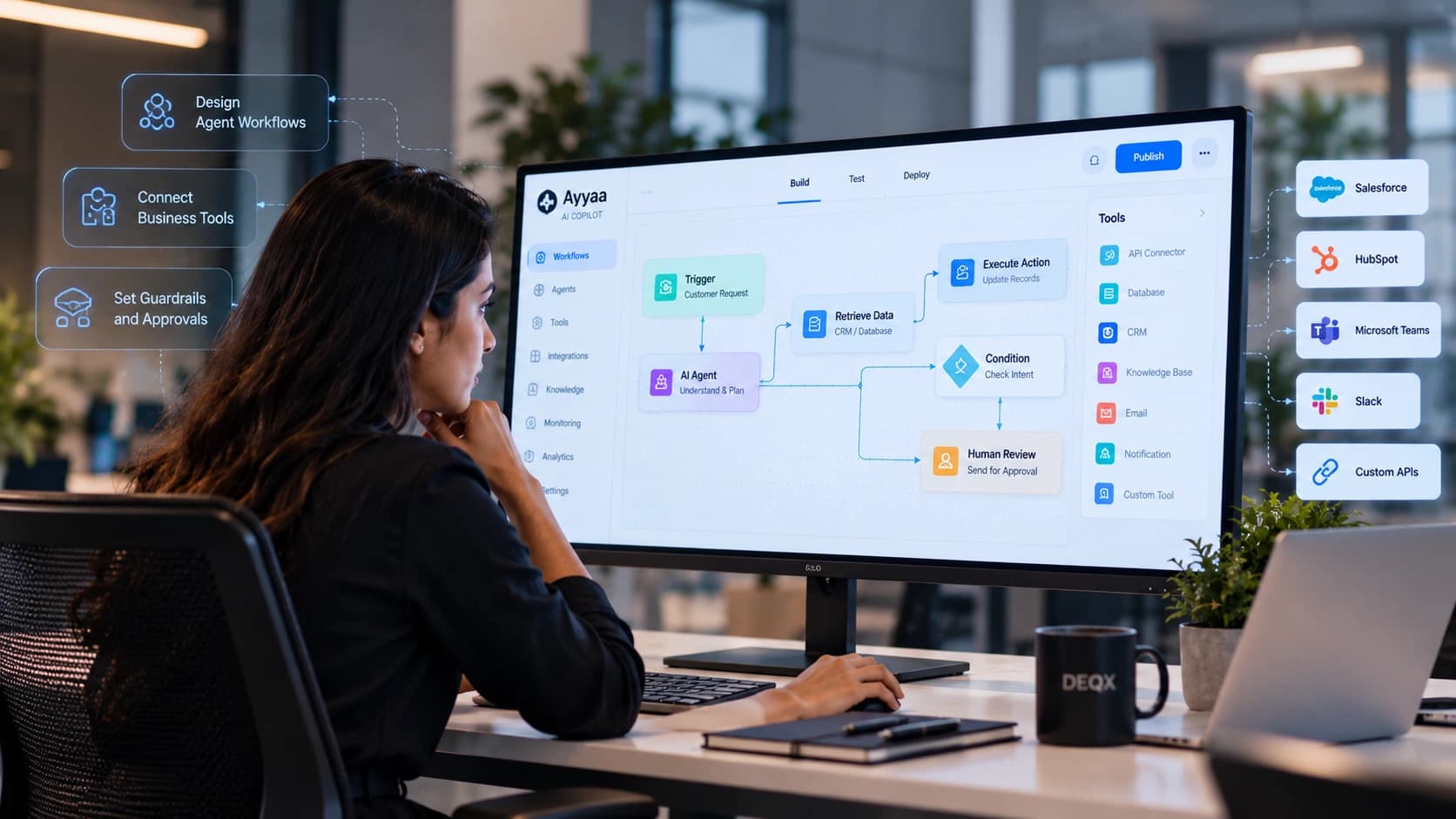
Configure agentic pipelines that connect to internal databases and APIs. Map triggers, decision branches, tool calls, and completion criteria with least-privilege access so orchestration stays inspectable before production.
Avyaa AI Copilot workflow builderShape the engagement around the work you need. Specific deliverables, access, responsibilities, and acceptance criteria are agreed during discovery.
A staged approach gives your team clear review points. Timing and responsibilities depend on the scope and the readiness of the systems involved.
01
Agree the workflow, users, data sources, and the evidence needed to judge whether the approach is useful.
02
Evaluate representative examples, failure cases, and human review needs before expanding the scope.
03
Connect the agreed capability to the application and its permitted tools, with access and exception handling defined.
04
Document evaluation, monitoring, ownership, and the improvement cycle needed after release.
Before we begin
A few questions to help frame your ai automation & intelligent agents project.
That depends on the action and the agreed risk boundaries. Low-impact tasks may run automatically, while approvals can be required for sensitive changes, commitments, or exceptions.
We begin with your current situation and the outcome you need. For this service, the discussion covers connect tools and context, design for exceptions, make execution inspectable. Deliverables, dependencies, review points, and commercial terms are agreed before implementation.
Handover, maintenance, and ongoing improvement are discussed as part of the engagement. The arrangement depends on your internal team, the systems involved, and the operating responsibilities you want DEQX to support.
An enterprise agentic AI workflow builder lets organizations visually model tasks, connect agents to approved tools and data, and set execution guardrails before automation runs. Teams define triggers, decision logic, permissions, retries, and escalation paths so agentic workflows stay inspectable, policy-aligned, and ready for human review when needed.
Agent assist surfaces relevant context, drafts responses, and prepares routine actions so people spend less time searching and more time deciding. Intelligent agents handle preparatory work; approvals, exceptions, and high-impact commitments remain with team members through defined handoff and review controls.
Let’s talk about your project
Tell us what you want to improve, what you have today, and the constraints that matter. We’ll help define a practical starting point.
Start a conversationCreate commerce experiences that bring product discovery, checkout, and business operations together. Build or improve the platform around your catalog, customers, fulfilment processes, and growth priorities.
Design and build custom applications, integrations, and digital platforms around your users and business processes. From a focused workflow to a larger enterprise system, connect product thinking with maintainable engineering.
Bring search, campaigns, content, and measurement into a coherent growth program. Focus on the audiences you need to reach, the experience they land on, and the business outcomes you can reliably measure.
Build cloud environments that support your applications, data, and AI workloads. Bring architecture, deployment, security, and operations into one practical plan for reliability and controlled growth.