Cloud Migration Checklist for Businesses: What to Assess Before Moving to the Cloud

Planning a cloud migration? Use this checklist to assess workloads, dependencies, security, data integrity, costs and rollback readiness before moving.
Short answer
What should a business evaluate before migrating applications and data to the cloud? Start with an inventory of applications, integrations, data volumes and dependencies. Assess the target environment, access needs, availability constraints, data integrity, security, costs and recovery requirements. Then follow a three-stage approach: map what needs to move, prepare and rehearse the migration, and cut over only with agreed transition and rollback conditions. Move in controlled stages, and verify application behaviour and data before cutover—not after users are already on the new environment.
DEQX Editorial Team
01 / Map what needs to move
What should a business assess before migrating to the cloud?
A business should understand its current environment before choosing a cloud migration strategy. Gartner forecasts end-user public cloud spending in India to reach US$17.5 billion in 2026, up 28.1% from 2025—useful market context, not proof that every workload should move. A cloud readiness assessment starts with what you run today, who depends on it, and which constraints the target environment must meet. Source: https://www.gartner.com/en/newsroom/press-releases/2026-06-01-gartner-forecasts-end-user-public-cloud-spending-in-india-to-surpass-17-billion-us-dollars-in-2026
Explore cloud migration services
01Inventory applications and workloads
Identify applications and services; servers, virtual machines and databases; file storage and backup systems; scheduled jobs and background processes; APIs and third-party integrations; application owners and business users; and software licences and support contracts. Document informal dependencies as well—spreadsheet imports, SFTP transfers, reporting scripts and external system connections—because undocumented links often surface only during cutover.
02Map integrations and dependencies
Record which applications communicate with each other, where data is stored, which systems rely on shared services, and which workloads should move together or remain separate. Dependency mapping shapes migration sequence and reduces the risk of moving one component before its supporting systems are ready.
03Record environment and operating constraints
Review environment and access requirements, availability needs, peak and average resource usage, traffic patterns and seasonal demand, performance expectations, data volumes and growth, business-critical operating periods, and current infrastructure and maintenance costs. The output of this stage should be a documented workload and dependency inventory, with clear owners and migration boundaries.
Migration readiness
Six areas to assess before moving workloads.
These checks help determine which workloads are ready to move, which need preparation, and which should remain in their current environment for now.
APPLICATION READINESS
Application readiness
Review operating systems, runtimes, databases, application architecture, compatibility, licences and support requirements.
DATA AND DEPENDENCIES
Data and dependencies
Identify data locations, volumes, integrations, shared services, transfer requirements and workloads that need to move together.
SECURITY AND ACCESS
Security and access
Review identities, permissions, authentication, encryption, secrets, network controls, logging and vulnerability management.
AVAILABILITY AND PERFORMANCE
Availability and performance
Define uptime expectations, response times, network requirements, capacity needs, peak workloads and application tolerance for parallel operation.
COST AND LICENSING
Cost and licensing
Evaluate compute, storage, networking, data transfer, backup, monitoring, software licences, migration effort and ongoing support.
RECOVERY AND BUSINESS CONTINUITY
Recovery and business continuity
Define backup requirements, recovery point objectives (RPO), recovery time objectives (RTO), restore testing, rollback conditions and operational responsibilities.
02 / Design the change
Which cloud migration strategy should a business choose?
Different workloads need different approaches. Do not assume every application must be rebuilt or moved in the same way. Workload suitability, performance, security, data requirements and operating economics should drive placement—public cloud, private infrastructure or on-premises. Reporting on cloud repatriation shows many organisations are selectively reassessing where workloads belong rather than rejecting cloud outright. Source: https://www.cio.com/article/4245967/cloud-repatriation-on-the-rise-but-tricky-questions-remain.html The categories below are common strategy options, not a mandatory sequence.
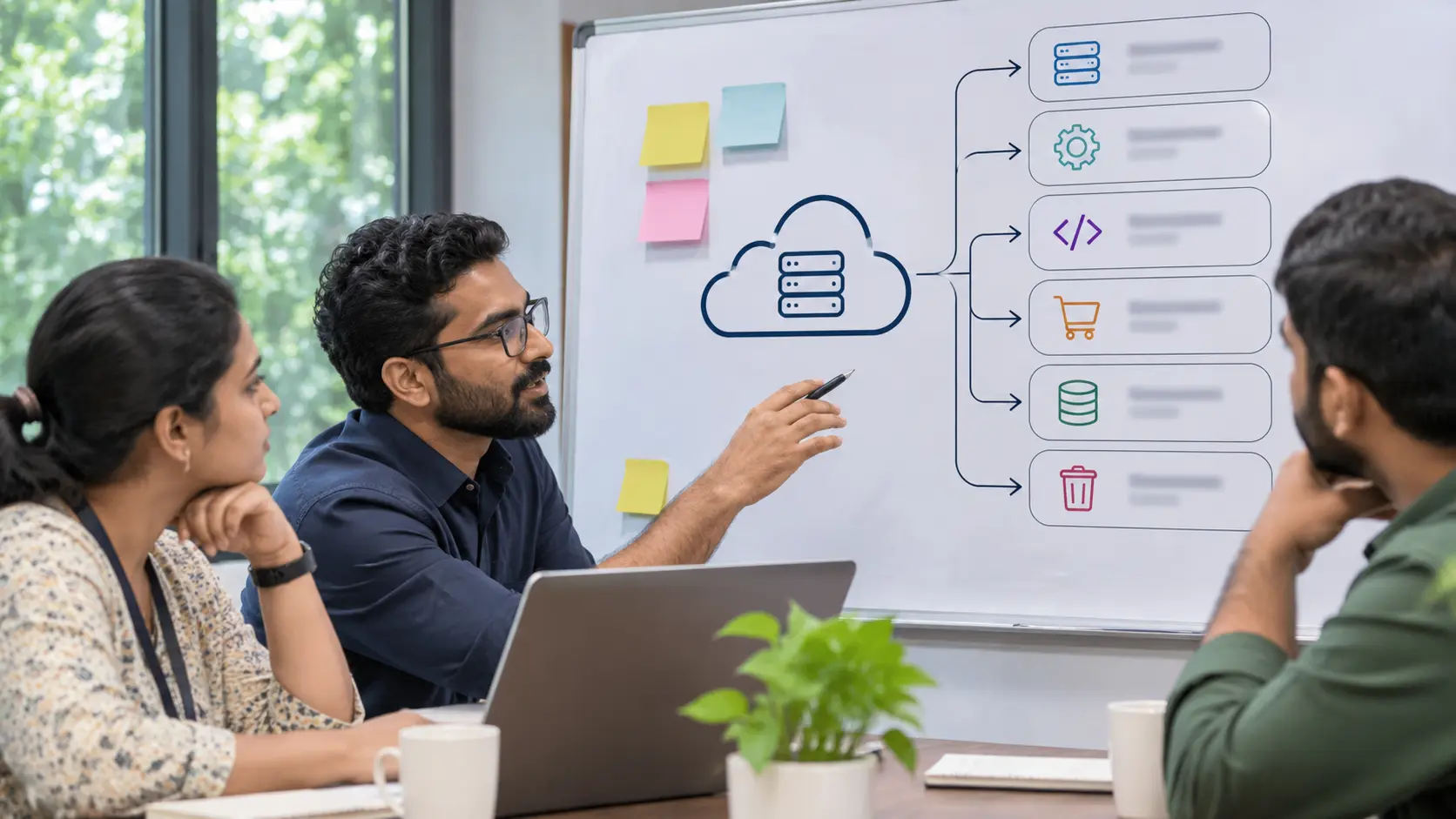
01Rehost
Move an application to cloud infrastructure with minimal application changes. Suitable when the priority is leaving existing infrastructure without a major redesign. Rehosting does not automatically remove technical debt or improve architecture.
02Replatform
Move an application while making selected changes to its platform, database or supporting services.
03Refactor or re-architect
Modify application code or architecture to use cloud capabilities. This usually needs more engineering, testing and planning.
04Repurchase
Replace an existing application with a suitable cloud-based SaaS product when it better meets business requirements.
05Retain
Keep a workload in its current environment when migration is not justified, feasible or commercially sensible.
06Retire
Decommission applications or infrastructure that are no longer required. Illustrative scenario only—not a DEQX customer project: a business might rehost an internal reporting application, replatform a customer portal, refactor a high-change application, retain a hardware-dependent system temporarily, and retire unused servers.
03 / Prepare and rehearse
What should businesses test before migrating applications and data?
Validate before cutover. Testing should use agreed acceptance criteria. Unresolved critical issues should be fixed before production cutover.
PREPARE THE TARGET ENVIRONMENT
Prepare the target environment
Configure required cloud resources, networking, identity, access permissions, storage, databases and security controls.
REHEARSE THE MIGRATION PROCEDURE
Rehearse the migration procedure
Test migration steps with a representative workload or test environment. Find sequencing issues, missing dependencies and failure points before production.
VERIFY DATA INTEGRITY
Verify data integrity
Validate data volumes, record counts, critical fields, relationships, checksums where appropriate, and application-level consistency. A successful file transfer does not prove the data is correct.
TEST APPLICATION BEHAVIOUR
Test application behaviour
Verify functionality, APIs, integrations, scheduled jobs, authentication, response times and important business workflows in the target environment.
TEST RECOVERY AND ROLLBACK
Test recovery and rollback
Document recovery procedures and confirm the team can restore the previous operating state if validation fails.
04 / Security, cost and operational readiness
What security and cost checks should happen before cloud migration?
Migration readiness is more than application compatibility. Data protection, access, cost and ongoing operating responsibilities must be understood before cutover. In Europe, digital sovereignty themes—operational autonomy, control of encryption keys, data jurisdiction, resilience and exit options—are influencing procurement for governments and regulated industries. That is European procurement context, not an Indian regulatory requirement. Source: https://www.reuters.com/business/finance/europes-cloud-sovereignty-push-gains-ground-us-hyperscalers-remain-dominant-2026-11-23/
Explore cloud security
01Classify data and review compliance
Identify personal data, financial information, confidential business records and regulated datasets. Review data location and jurisdiction, applicable privacy and sector-specific requirements, retention and deletion policies, access and audit needs, and contractual obligations. For Indian organisations, consider the Digital Personal Data Protection Act, 2023 and applicable rules, alongside sector-specific obligations. Indian law does not automatically require all personal data to remain in India; requirements depend on applicable law, government restrictions and sector rules. This is general technical guidance, not legal advice.
02Design security and access controls
Review identity management, multifactor authentication, role-based permissions, privileged accounts, service identities, encryption, key management, secrets management and network segmentation. Under the shared-responsibility model, cloud providers and customers hold different duties depending on the service model and configuration. Datadog’s State of Cloud Security 2026, as reported by Express Computer, found that serious vulnerabilities in analysed cloud services rose sharply over nine months, and highlighted risks from long-lived credentials and software dependencies—reasons to treat access restriction, temporary credentials, vulnerability management and dependency visibility as part of migration readiness, without treating any single report’s rates as universal. Source: https://www.expresscomputer.in/cloud/serious-cloud-vulnerabilities-rise-fourfold-in-nine-months-datadog-report/141227/
03Estimate migration and ongoing costs
Include cloud compute and storage, connectivity and data transfer, backup and disaster recovery, monitoring and security services, software licences, migration tools and engineering effort, temporary parallel infrastructure, and support. Compare total cost of ownership, not server unit prices alone.
04Define post-migration operations
Plan monitoring, alert escalation, access reviews, backup schedules, incident response, utilisation tracking, cost reporting and maintenance ownership. Treat cost governance and FinOps as ongoing collaboration between engineering, finance and business teams—not a one-time spreadsheet exercise. After migration, cloud monitoring and infrastructure practices help keep the environment supportable: https://deqx.ai/services/cloud-monitoring and https://deqx.ai/services/infrastructure-automation
05 / Cut over with control
How can businesses migrate workloads without unnecessary disruption?
Cutover should be planned around architecture, data synchronisation needs, dependencies and tolerance for parallel operation. Do not promise zero downtime. Some migrations need a planned maintenance window. Where low-downtime or parallel operation is feasible, validate it for that specific workload. DEQX’s cloud migration approach follows map the environment, design the change, implement and verify, then establish ownership.
Plan your cloud migration
01Agree the transition window
Identify business-critical periods, stakeholder availability, support coverage, expected user impact and the appropriate migration window.
02Define validation and go/no-go criteria
Specify what must be verified before switching traffic or users—application behaviour, data integrity, integrations, performance and security checks.
03Agree rollback conditions
Document when migration should pause or reverse, who decides, how the previous environment is restored, and how data consistency is maintained. A cloud migration rollback plan is an operating control, not an optional appendix.
04Establish ownership after migration
Prepare runbooks, monitoring, alert escalation, access reviews, maintenance responsibilities and ongoing cost reporting. After the move, review application availability; response time and performance; failed transactions and integration errors; data reconciliation; backup and restore tests; RTO and RPO performance; security findings and access-review completion; cloud spend against budget; resource utilisation; operational incidents and user feedback.
Questions from business and technology teams
Planning a cloud migration project
What is a cloud migration checklist?
A cloud migration checklist is a structured assessment of applications, workloads, data, dependencies, security, costs, recovery and operational readiness before moving systems to cloud infrastructure.
What should a business check before migrating to the cloud?
Review application compatibility, workload requirements, dependencies, data volumes, security and access, performance expectations, costs, backup and recovery, and who will own the environment after cutover.
How do businesses prepare for a cloud migration?
Inventory workloads, map dependencies, prepare the target environment, rehearse the migration, test applications, validate data, and agree cutover and rollback conditions before production change.
Can businesses migrate to the cloud without downtime?
Some architectures support low-downtime transitions, but that cannot be assumed. It depends on data synchronisation, dependencies, application design and tolerance for parallel operation. Some migrations need a planned maintenance window.
How do businesses protect data during cloud migration?
Classify data, use encryption and access controls, transfer securely, run integrity checks, keep tested backups, maintain logging, and rehearse recovery before cutover.
How long does a cloud migration take?
Duration depends on workload complexity, data volumes, integrations, migration strategy, testing depth, business constraints and operational readiness. Complete a discovery assessment before preparing an estimate.
Talk to DEQX
Move your workloads with a clear transition plan.
Understand what needs to move, prepare and validate the target environment, and plan a controlled cutover around your applications, data and business continuity requirements.
Discuss Your Cloud MigrationExplore cloud infrastructure
Keep your cloud environment reliable after migration.
Explore cloud monitoring, infrastructure automation, security and operational practices that help teams manage and maintain their cloud environments.
Explore Cloud InfrastructureAbout this article
A practical guide to cloud migration readiness.
This article provides general guidance for assessing and planning cloud migrations. Migration architecture, provider selection, security controls, compliance obligations, costs, cutover methods and timelines depend on each organisation’s workloads, contracts, technical environment and operational constraints. Examples are illustrative and do not represent a specific DEQX customer deployment or measured project outcome.
More Recent Insights
Stay up-to-date with our latest findings and perspectives.

Legacy System Modernization: How to Upgrade Old Business Software Without Disrupting Operations
Learn how to modernise legacy business software in stages, map system dependencies, improve integrations and protect essential operations without replacing everything at once.

Predictive Maintenance with Machine Learning: From Sensor Data to Early Warnings
How machine learning analyses equipment sensor data to identify early warning signs, estimate potential failures and help industrial teams plan maintenance before breakdowns occur.

B2B Ordering Portals: Replacing WhatsApp and Excel Orders for Distributors
How distributors can move dealer orders out of chat threads and spreadsheets into one ordering system, while keeping WhatsApp for the conversations dealers value.